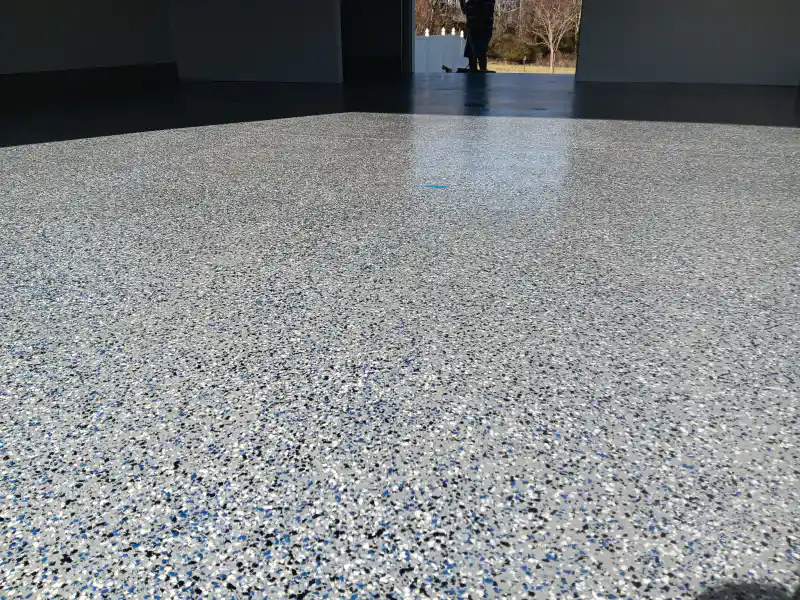
Most people picture the flakes and the gloss. The part that decides whether an epoxy garage floor lasts happens before any of that, on bare concrete, with a moisture meter and a grinder.
What does a Greenville garage slab have to pass before epoxy?
Every epoxy floor product ships with a technical data sheet, and that sheet is the real spec for your garage. It lists how dry the concrete has to be, how rough the surface needs to be, how old a new slab must be, and the air and slab temperatures allowed on the day the coating goes down.
Below we quote two published sheets as examples: Sika's Sikafloor-264, a two-part epoxy whose sheet lists garages among its uses, and Rust-Oleum's EpoxyShield garage floor kits. They are examples only. The coating on your job has its own sheet, and those are the numbers that count.
A floor that has settled or cracked through is a different question, covered in our guide on when a Greenville garage slab needs replacing. Our shop is in Taylors, and we work as a concrete contractor in Greenville and across the Upstate.
How is moisture in a garage slab tested before epoxy?
ASTM's summary of its F2170 test lists debonding and deterioration of coatings among the failures excess slab moisture causes, and says flooring makers generally require a moisture test before installation.
You will hear about three tests. ASTM F1869 uses anhydrous calcium chloride on bare concrete and reports pounds of moisture vapor per 1,000 square feet over 24 hours. F2170 reads relative humidity inside the slab with in situ probes.
The quick one is ASTM D4263, the plastic sheet method, which ASTM describes as a way to indicate capillary moisture before coatings go on concrete. Sika's sheet points to D4263 as a visual check and wants no vapor drive at the time of application.
The pass marks come from the coating sheet. Sikafloor-264 wants 4 percent moisture by weight or less on a Tramex CME meter, or 85 percent relative humidity or less if F2170 is run, and names a different Sika product above those numbers. All three Rust-Oleum sheets say their products are not meant for floors with a moisture problem.
One catch, straight from ASTM's own pages: a moisture reading describes the slab only on the day it was taken, in the spots tested.
Grinding or acid etching: how rough does a garage floor need to be?
Roughness is graded on the International Concrete Repair Institute's concrete surface profile scale, CSP 1 through CSP 10. KTA-Tator's summary of the ICRI chip set ties the low numbers to prep methods: acid etching for CSP 1, grinding for CSP 2, a light shotblast for CSP 3 and light scarification for CSP 4.
This is where products split. Sika's sheet calls for mechanical prep to CSP 3 to 4, after laitance, oil, brake fluid, old paint and other contaminants come off. The Rust-Oleum garage kits are built around their own Concrete Etch, so the profile a sheet asks for tells you a lot about the system.
The Rust-Oleum solvent-based sheet includes a sealer check you can do yourself. Sprinkle a little water on the floor; if it beads up instead of soaking in, there is a sealer on it, and the sheet says that sealer has to be sanded or ground off before coating.
How long does a new garage slab in Greenville need before coating?
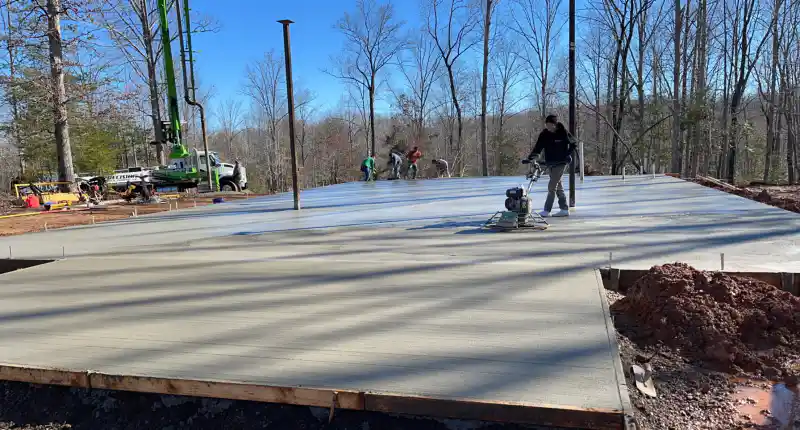
All three Rust-Oleum sheets say to let new concrete cure at least 28 days. Sika frames it by strength instead, asking for concrete of at least 3,625 psi at 28 days and at least 218 psi in tension on the day of application.
Day 28 doesn't excuse the moisture test. A new slab still has to come in under the sheet's moisture limit on its own, and that limit is checked the day of the job.
Why humid Greenville summers make epoxy timing tricky
Each sheet here carries a dew point rule. Sika and the Rust-Oleum pouch kit both want the slab surface at least 5°F above the dew point, and Sika warns that condensation can cause adhesion failure or blushing, adding that the slab may run cooler than the air.
NOAA's 1991 to 2020 hourly normals for Greenville-Spartanburg International Airport show how tight that gets on an average summer day:
| Month | Coolest hour: air / dew point | Spread | Warmest hour: air |
|---|---|---|---|
| June | 67°F / 63°F | 3.9°F | 84°F |
| July | 71°F / 67°F | 3.5°F | 87°F |
| August | 70°F / 67°F | 3.2°F | 86°F |
| September | 64°F / 61°F | 3.7°F | 81°F |
At the coolest hour the spread sits under 5°F all four months, before you account for a slab cooler than the air. By mid-afternoon in July and August the air is past the 85°F top limit on both the Sika sheet and the pouch kit, and NOAA's monthly normals put the average July high at the airport at 90.3°F.
Air humidity is capped too. Sika sets a maximum of 85 percent relative humidity during application and curing, and the pouch kit sheet uses the same 85 percent figure. Sika also wants the resin itself stored between 65 and 75°F for at least 24 hours before mixing, which takes some planning when normal afternoon air at the airport runs 84 to 87°F from June through August.
The pouch kit sheet also says that between 71 and 85°F the best time to paint is early morning, before 9 AM, while Sika warns against coating as temperatures are rising because pinholes may form. Those are airport readings, and a closed garage behaves differently, which is why Sika says to measure slab temperature, humidity and dew point before starting and record them at least every 3 hours.
Cracks, joints and the first drive on a new epoxy floor
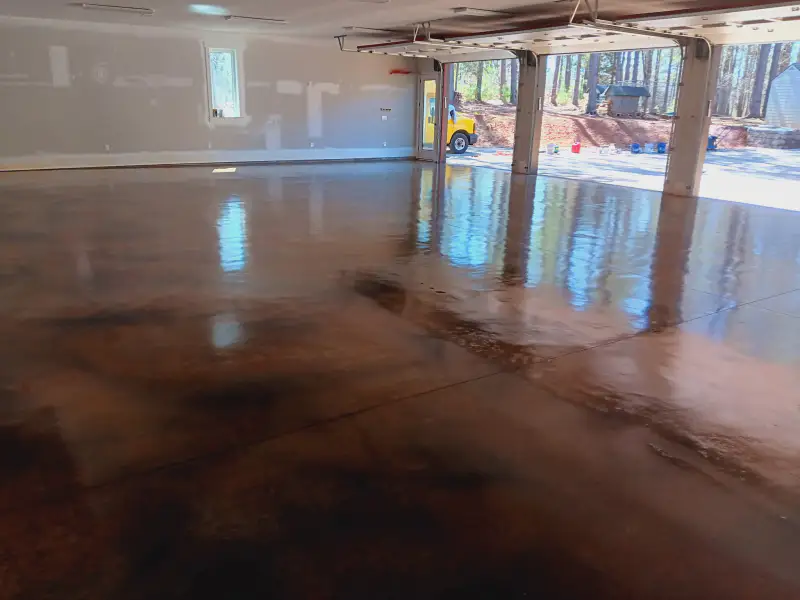
Sika's sheet says blowholes and uneven spots get filled and leveled with a repair mortar before coating, on concrete that is clean and sound. Saw-cut control joints are part of the slab too, and how they get handled is worth settling before the job starts.
A crack that is still moving is a separate problem, covered in our guide to concrete crack repair in Greenville.
Then comes the wait to drive on it. The Rust-Oleum water-based kits list vehicle traffic at 3 days and the solvent-based sheet at 4 days, and Sika lists full cure at about 4 days at 86°F and about 10 days at 50°F.
Tire marks are their own issue. Armorpoxy, an epoxy floor maker, blames tire staining on plasticizers in the rubber leaching out, most often after the tires heat up from driving, and suggests a high-performance topcoat. Sika's sheet also says its epoxy will discolor over time in sunlight, worth mentioning if your garage door stays open to the afternoon sun.
For the coating work itself, see our page on epoxy floor coatings in Greenville, or send the address and floor size through the estimate form below.
Sources: Sika USA, Sikafloor-264 Product Data Sheet, September 2026, Version 08.05; Rust-Oleum, EpoxyShield Water-based Epoxy Garage Floor Coating (Pouch Kits) technical data, Form GDH-1219; Rust-Oleum, EpoxyShield Water-based Epoxy Garage Floor Coating technical data, Form GDH-356; Rust-Oleum, EpoxyShield Solvent-based Professional Floor Coating technical data, Form GDH-1000; ASTM, F1869-23, F2170-19a and D4263 standard summaries; KTA-Tator, Let's Talk Measuring Concrete Surface Profile (ICRI CSP chip table); NOAA NCEI, 1991 to 2020 monthly normals and 1991 to 2020 hourly normals, Greenville-Spartanburg Airport (USW00003870); Armorpoxy, tire staining help article. All read October 9, 2026.